Best Stocks for Swing Trading: How to Find Setups
Fewer than 2% of stocks produce the majority of market gains in any given year — William O'Neil documented this pattern in How to Make Money in Stocks (2009) across decades of research into the biggest stock market winners. The best stocks for swing trading sit in that narrow tier. The challenge is building a repeatable process to find them before they run, not after.
This guide covers the five quantitative criteria that define a high-conviction swing trade candidate, the EasySwing.trading screening workflow that surfaces them in under 60 seconds, and the market regime context that determines whether to act or wait.
What Defines the Best Stocks for Swing Trading
The best stocks for swing trading share four measurable properties: a confirmed Stage 2 uptrend, a Relative Strength rank above 85, a named technical setup with a clear entry trigger, and sufficient daily volume to enter and exit cleanly within 2-5 days. Market regime adds a fifth filter — the same stock in the same pattern carries different probability in a Trending Up environment versus a Choppy or High Volatility one.
Searching for "most active" or "biggest movers" typically surfaces stocks that have already run. The better approach: screen for stocks that are structurally prepared to move, based on setup formation — not recent price action. The pattern is the trigger; the Stage 2 trend and RS rank confirm the stock is worth trading.
According to Minervini's backtested data in Trade Like a Stock Market Wizard (2013), over 70% of his winning trades from 1997–2007 showed a VCP-type consolidation before their breakout — inside an existing Stage 2 uptrend. The pattern is the what; the confirmed uptrend is the when.
Five Criteria That Define a High-Conviction Setup
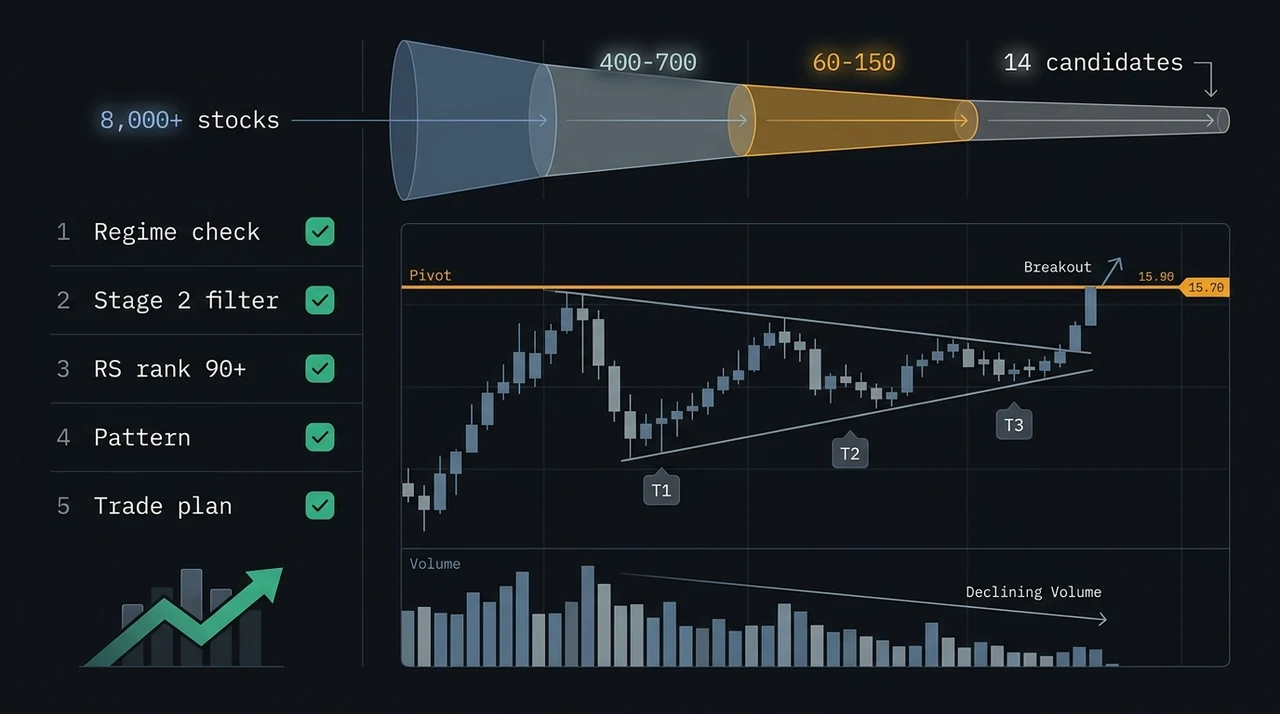
Every stock on the EasySwing shortlist clears five quantitative layers before appearing in results. Any stock missing one of the five is skipped or sized smaller.
The five criteria are: RS rank at or above 85, a Stage 2 moving average stack, a named setup pattern with a defined entry trigger, relative volume of 1.5× or higher on the trigger candle, and an EasySwing grade of B or better. Each filter removes a specific category of low-probability setups.
| Criterion | Minimum Threshold | What It Filters Out |
|---|---|---|
| RS Rank | ≥ 85 | Weak relative performers — no institutional demand signal |
| Stage 2 MA stack | Price > 50d > 150d > 200d (200d rising) | Stocks in downtrend or sideways base — against the trend |
| Named setup pattern | VCP, cup & handle, trend pullback, RSI bounce, etc. | Random technical screens — no defined entry, stop, or target |
| Relative volume | ≥ 1.5× 50-day average on trigger | Low-liquidity breakouts — risk of failed follow-through |
| EasySwing grade | B or better | Extended entries, weak RS, incomplete MA stack |
The RS rank cutoff is supported by Minervini's own trading data. In Momentum Masters (2012), more than 70% of his winning trades had RS rank above 85 at entry. Below 70, average gain per trade declined meaningfully — the institutional buying pressure that drives swing trade profits was absent.
Why Grade Is the Most Useful Single Filter
Most screeners stop at the pattern. EasySwing's grade (A+/A/B+/B/C) is a composite signal that collapses four measurements into one: entry efficiency (how close the current price is to the setup's pivot), MA stack alignment, RS rank percentile, and volume confirmation quality.
A Grade A VCP in a Trending Up regime is a fundamentally different trade from a Grade C VCP in a High Volatility regime — even if the chart pattern looks identical. The grade handles that distinction automatically. Filtering for Grade B and above removes roughly 60–70% of screener results and retains the highest-quality setups as your working list.
The EasySwing Screening Workflow
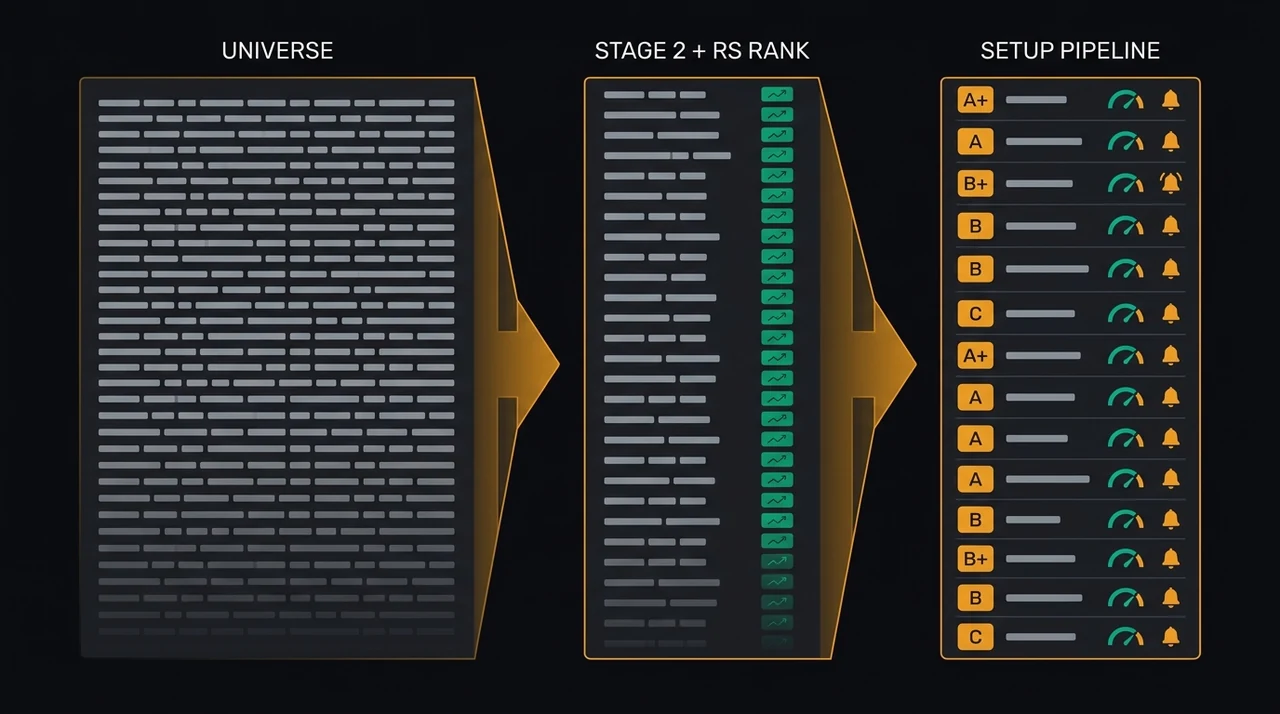
EasySwing.trading scans 2,000+ stocks through the five-layer criteria daily. The practical workflow to reach a shortlist of this week's best setups takes under 60 seconds.
Open the StockFinder panel, switch to Strategy Mode, set the minimum grade to B, verify the regime shows Trending Up or Ranging, then sort by momentum score descending. The top 10 rows are your starting shortlist.
Step 1 — Strategy Mode. Switch from Raw Filters to Strategy Mode. This changes the logic from "return stocks matching indicator conditions" to "return stocks currently in a named setup with pre-calculated entry, stop, and targets." Every result is a tradeable structure — not a raw condition match that still requires manual pattern recognition.
Step 2 — Grade filter. Set minimum grade to B. Grade A setups combine strong RS rank, tight entry proximity, and volume confirmation — these are the cleanest-quality matches. Grade B is acceptable with conservative initial sizing. Grade C is the lowest-quality bucket, where one or more quality factors falls below threshold.
Step 3 — Momentum sort. Momentum score (0–100) is a composite of RS rank, 20-day rate of change, and relative volume over 20 sessions. Sorting descending surfaces the highest institutional buying pressure first. These setups tend to follow through faster and further than lower-momentum equivalents.
Step 4 — Regime check. Before acting on any result, check the regime banner. Trending Up supports breakout setups (VCP, bull flag, cup and handle). Ranging supports reversion setups (pullback to MA, RSI bounce). High Volatility or Trending Down means reduce exposure — these environments punish new breakout entries.
For a full walkthrough of this workflow, see our guide on using a stock screener for swing trading.
Market Regime and Setup Selection
The same stock in the same setup carries materially different probability depending on current market conditions. In a Trending Up regime, breakout setups have win rates 20–30 percentage points higher than in a Choppy or High Volatility environment — the rising market carries individual breakouts further and sustains them longer.
EasySwing's regime classification uses five states: Trending Up, Ranging, Transitioning, High Volatility, and Trending Down. The regime gate prevents Grade A VCP setups from appearing in live screener results when the market is in a Trending Down or High Volatility state. Same stock, same pattern — different context, different probability.
| Market Regime | Best Setup Types | Reduce or Avoid |
|---|---|---|
| Trending Up | VCP, bull flag, cup & handle, stage 2 breakout | Short reversion setups |
| Ranging | Pullback to MA, RSI oversold bounce | Wide-base breakouts |
| High Volatility | Tighten stops; reduce size to 25–50% | New long breakout entries |
| Trending Down | Bear flag short (experienced traders only) | Long breakouts at any grade |
| Transitioning | Wait for confirmation | New entries of any kind |
For more on reading market context before placing setups, see market regime: bull, bear, and choppy.
Converting a Screener Result Into a Trade
A screener result is a starting point — not an entry signal. The final step before placing any order is verifying that the risk/reward ratio makes the trade worth taking at the current price.
EasySwing pre-calculates entry price, stop-loss, Target 1 (T1), and Target 2 (T2) for every result. The standard minimum: a 2:1 reward-to-risk ratio to T1. If the current price has already moved 7% above the entry trigger, the ratio may no longer reach 2:1 — and the trade should be passed or held until a pullback returns it to the pivot zone.
Jegadeesh and Titman (Journal of Finance, 1993) documented 12.01% annual returns above benchmark from momentum stocks over 25 years of data. Those returns assume disciplined position sizing — not concentrated bets on single ideas. The practical framework: risk 0.5–1% of total portfolio equity per trade. Set the stop at the structural low of the pattern — the low of the handle in a cup, the low of the final contraction in a VCP. This keeps the stop objective and removes discretionary second-guessing on exits.
For the complete position sizing framework using R-multiples, see position sizing for swing trading.
Pre-Entry Checklist for the Best Swing Trade Candidates
Before entering any trade based on a screener result, run through each item:
- ✅ Stage 2 confirmed: price > 50d MA > 150d MA > 200d MA, with 200d MA rising
- ✅ RS Rank ≥ 85 (visible in the EasySwing grade breakdown panel)
- ✅ EasySwing grade B or better
- ✅ Market regime is Trending Up or Ranging
- ✅ Entry price is within 5% of the setup's pivot or trigger level
- ✅ Stop is at the structural low of the pattern — not an arbitrary percentage
- ✅ Reward:risk ≥ 2:1 to Target 1 at the current entry price
- ✅ Volume confirms: relative volume ≥ 1.5× on breakout candle or within two days after
- ❌ Do not enter more than 7% above the pivot — the reward:risk ratio falls below the 2:1 minimum
- ❌ Do not buy breakout setups in a Trending Down or High Volatility regime
- ❌ Skip stocks with RS Rank below 70 — institutional demand is absent
- ❌ Never enter without a defined stop — undefined risk is the primary driver of account drawdowns
Frequently Asked Questions
What are the best stocks for swing trading this week?
The current best stocks for swing trading depend on which setups are triggering and what the market regime shows — both change weekly. EasySwing.trading scans 2,000+ stocks daily. Open the StockFinder, set minimum grade B, confirm regime is Trending Up or Ranging, and sort by momentum score descending. The top results carry pre-calculated entry, stop, and target levels based on today's data.
How many swing trades should I hold at once?
Three to eight positions is the typical range for active swing traders. Fewer than three concentrates risk on individual outcomes; more than eight makes daily monitoring difficult and tends to dilute quality — you end up holding Grade C setups because Grade A and B results have been exhausted. EasySwing's momentum sort keeps you focused on the top setups in the current environment.
What market cap range is best for swing trading?
The $500M–$15B mid-cap range produces the best combination of momentum and liquidity for most swing traders. Stocks below $200M carry higher gap risk and thinner volume on exit. Large caps above $20B move more slowly and require larger absolute price moves to reach 1.5–2× reward targets. EasySwing's universe focuses on the $200M–$20B range by default.
How do I know when to exit a swing trade?
EasySwing pre-calculates Target 1 (1.5–2× risk) and Target 2 (3–4× risk) for every setup. Standard approach: take half the position off at T1, move the stop to breakeven, and hold the remainder to T2. Time-stop: if the stock has not moved toward T1 within 10–15 trading days, exit and redeploy capital into a fresher setup with momentum behind it.
Can I use EasySwing to find short-side swing trades?
Yes. EasySwing detects two short setups — Bear Flag and RSI Overbought — alongside five long setups. Short setups are most reliable in Trending Down or High Volatility regimes when the market is under distribution. The same quality grading (A+/A/B+/B/C) applies to short setups — a Grade A bear flag in a confirmed downtrend carries the same probability edge as a Grade A VCP in a confirmed uptrend. For more, see the bear flag short setup guide and the full swing trading strategies overview.
EasySwing.trading screens for the best swing trading setups automatically — RS rank, Stage 2 structure, named pattern detection, and quality grading all computed daily across 2,000+ stocks. For more on the indicators powering each detection layer, see best indicators for swing trading. To understand the RS rank filter in depth, read relative strength rank for swing trading. Scan results are for informational purposes only. See our Risk Disclaimer.
Disclaimer: This article is for educational purposes only and does not constitute investment advice. EasySwing is a stock screening tool, not a registered investment advisor. All trading involves risk. Read our full disclaimer →