EasySwing vs Finviz: Which Screener Fits Swing Traders?
William O'Neil's study of the greatest stock market winners (How to Make Money in Stocks, 2009) found that 95% formed an identifiable base pattern before their major advance. Whether your screener can detect that pattern — before the breakout, not after — is the question that separates EasySwing.trading and Finviz in practice.
Both tools screen stocks. They approach the problem from opposite architectural choices: one is a general-purpose filter engine; the other is a purpose-built swing trading scanner. This comparison covers the practical differences in screening model, setup quality scoring, market regime awareness, and workflow fit.
What EasySwing.trading and Finviz Are
Finviz is a general-purpose stock research platform with 80+ filter parameters spanning fundamentals, technicals, and analyst data. EasySwing.trading detects named swing trading setups — VCP, Cup and Handle, trend pullback, and three others — and ranks each result by quality score, entry price, stop-loss, and market regime alignment.
Finviz is one of the most widely used stock screeners available, serving swing traders, fundamental investors, options traders, and ETF researchers alike. Its free tier provides delayed quotes with access to most technical and fundamental filters. Finviz Elite (~$25/month) adds real-time data, alerts, correlation analysis, and a portfolio tracker. Its breadth of use cases is its primary strength.
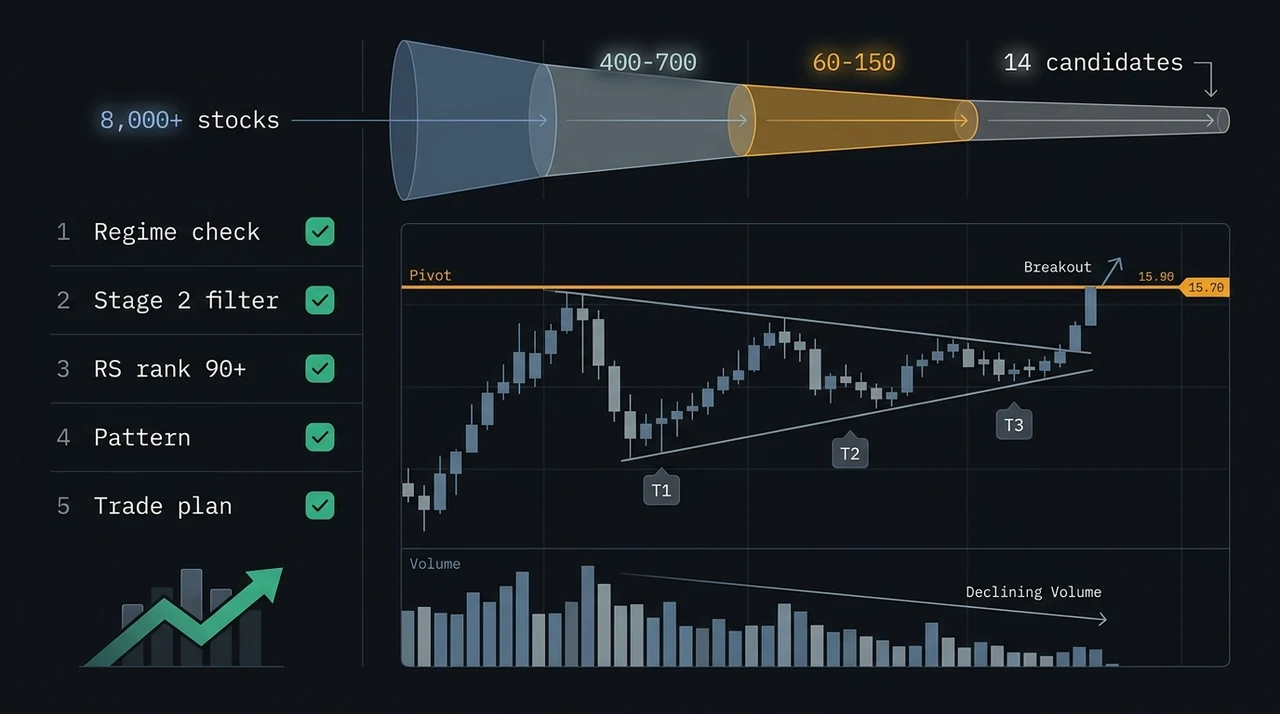
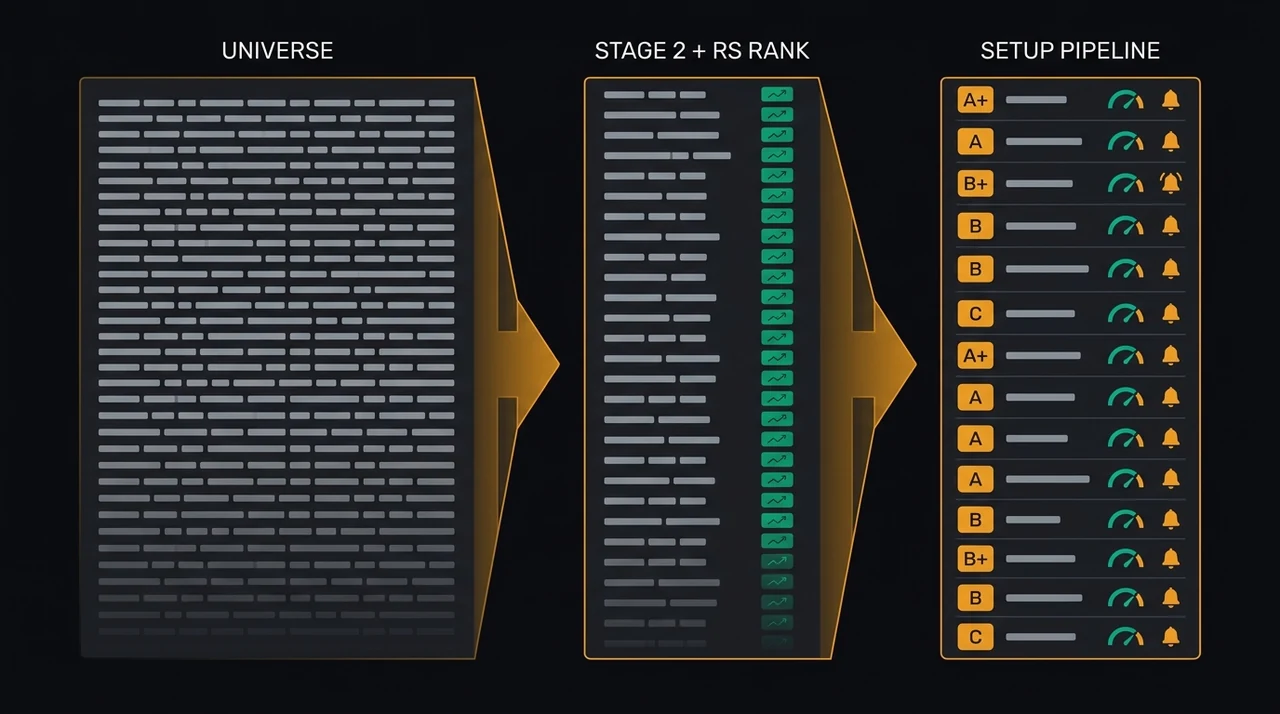
EasySwing.trading screens for 13 named swing trading patterns using a signal engine that simultaneously checks trend phase (Stage 2 or Stage 4), relative strength rank, relative volume, market cap, and market regime. Stocks clearing every condition appear in a ranked list with a quality grade (A+/A/B+/B/C), composite score (0–100), and pre-calculated entry price, stop-loss, and two profit targets. Plans start at $49/month ($39/month with annual prepay).
The core difference: Finviz returns stocks that pass your filter criteria. EasySwing.trading returns stocks in named setups with a pre-scored, pre-structured risk/reward framework.
The Screening Model: Filter Assembly vs Strategy Detection
Finviz returns every stock that clears your filter criteria. Pattern recognition and quality judgment remain your job. EasySwing.trading runs multi-layer detection — trend structure, RS rank, volume, pattern formation, and market regime — and delivers a ranked, scored list. The difference is where the synthesis happens: in the tool, or in the trader.
Finviz's model: You define the conditions — RSI below 40, price above SMA200, average volume over 500K, market cap between $1B and $10B. The screener returns every stock clearing each filter. You then review results chart-by-chart to identify which are in a tradeable setup. Advanced users build elaborate Finviz filter stacks that approximate swing trading criteria — but pattern recognition and quality judgment happen manually after the screen runs.
EasySwing.trading's model: You select a strategy, or run all 13 simultaneously. The engine evaluates conditions in sequence: Stage 2 trend structure, RS rank threshold, relative volume confirmation, named pattern formation, and market regime gate. Stocks clearing every layer appear ranked by a 0–100 composite score. Pattern recognition and quality scoring are built into the engine — the trader starts from a graded list rather than from raw filter results.
Mark Minervini documents this principle in Think and Trade Like a Champion (2017): "Every minute you spend reviewing a mediocre setup is a minute not spent on an exceptional one. Your job is to reduce your list to only the best candidates." Purpose-built detection handles that reduction automatically.
Finviz suits traders who want full control over filter construction and are willing to do chart-by-chart review themselves. EasySwing.trading suits traders who want to start from a ranked list of pre-scored setups and focus their time on the final entry decision.
Setup Quality Grading and Pre-Set Risk/Reward
Finviz has no setup quality scoring — every stock clearing your filters ranks identically. EasySwing.trading assigns each result a letter grade (A+/A/B+/B/C) and a composite score (0–100) weighted across RS rank, momentum, volume confirmation, pattern quality, and regime fit. Every result includes a pre-calculated entry price, stop-loss, and two profit targets.
The grading model weights five dimensions:
| Metric | Weight | What It Measures |
|---|---|---|
| RS rank | 30% | Relative price strength vs. the broad market |
| Momentum score | 25% | Rate of price acceleration over 20 and 60 days |
| Volume confirmation | 20% | Relative volume vs. 50-day average at the trigger |
| Setup quality | 15% | How closely price action matches the pattern definition |
| Regime alignment | 10% | Whether the current market regime supports this strategy |
Every result also carries a pre-calculated entry price, a stop-loss placed below the pattern's defining low, and two targets: Target 1 at 1.5R and Target 2 at 3R. Position sizing is one calculation away from any result.
Finviz does not provide entry, stop, or target levels — the trader builds the risk/reward framework independently from the chart. For traders with a defined methodology for setting entries and stops, this adds minimal friction. For traders still developing that methodology, the pre-built structure in EasySwing.trading reduces ad-hoc variation across positions.
For the indicator framework that feeds into these scores, see Best Indicators for Swing Trading: The 5 That Actually Work.
Market Regime Awareness
Market regime is the variable most commonly absent from retail screening workflows. Andreas Clenow documented in Stocks on the Move (2019) that momentum strategies produced roughly a 58% win rate in trending markets versus 43% in non-trending conditions — a 15-percentage-point swing in expected outcome driven entirely by market context. Finviz applies no regime filter — both market conditions produce identical result counts.
Without a regime filter, momentum breakout alerts fire during a broad market correction with the same frequency as during a bull run. The chart patterns look identical. The follow-through probability is not.
EasySwing.trading classifies the current market into five regimes — Trending Up, Trending Down, Ranging, High Volatility, and Transitioning — based on index breadth, VIX level, ADX reading, and index price structure. Each strategy is gated against the current regime:
- In Trending Up: VCP, Cup and Handle, and trend pullback setups are promoted
- In Trending Down or High Volatility: short-side strategies are surfaced; long breakout signals carry reduced confidence
This means the same stock can produce different alert behavior depending on market conditions — matching the statistical reality that follow-through rates shift across regime states. For a breakdown of the five-regime framework, see Market Regime: How to Read Bull, Bear, and Choppy Markets.
Where Finviz Holds the Advantage
EasySwing.trading does not outperform Finviz across every dimension. Finviz's 80+ filters include fundamental data — P/E ratio, EPS growth, debt-to-equity, insider ownership, analyst ratings — that EasySwing.trading does not surface as stand-alone parameters. Finviz's free tier also makes it accessible for traders testing filter methodology without a subscription.
Three areas where Finviz holds a clear advantage:
1. Fundamental screening depth. Finviz offers filters for P/E ratio, forward P/E, EPS growth (5-year), debt-to-equity, current ratio, gross margin, ROE, analyst ratings, and sector/industry classification — none of which appear as stand-alone filter parameters in EasySwing.trading. For traders who require EPS growth or valuation screens alongside technical criteria, Finviz's depth is hard to match.
2. Free access. Finviz Free provides delayed data with access to most technical and fundamental filters at no cost. For traders still developing their filter methodology, experimenting at zero cost before committing to a paid subscription is a practical starting point.
3. Multi-style coverage. Finviz serves options traders, value investors, growth investors, and ETF researchers alongside swing traders. If you screen across multiple styles and need one tool to cover all of them, Finviz's breadth is an advantage.
Who Each Tool Fits
The right screener depends on your workflow. Finviz fits traders who build their own filter stacks, need fundamental data alongside technicals, or screen across multiple styles. EasySwing.trading fits traders who follow the Minervini/O'Neil methodology and want pre-scored setups with regime awareness and pre-calculated risk structures.
Finviz fits swing traders who:
- Have a defined filter framework developed over time
- Need fundamental factors (EPS growth, P/E, sector) as primary screening criteria
- Prefer to construct and refine their own technical conditions
- Trade across multiple styles — swing, options, value — with one tool
- Are testing a methodology and want free access during the learning phase
EasySwing.trading fits swing traders who:
- Want a ranked list of pre-scored, named setups to start from
- Follow Minervini, O'Neil, or Weinstein methodology and want a tool that encodes those criteria
- Prefer built-in regime gating over manual market condition assessment
- Want pre-calculated entry, stop, and target levels on every result
- Use strategy-specific alerts that encode the full condition set — see How to Set Up Swing Trading Alerts for the five-condition framework
Some traders use both: Finviz for fundamental filtering and initial universe narrowing, EasySwing.trading for final setup identification, scoring, and rank ordering.
EasySwing.trading vs Finviz: Feature Comparison
| Feature | EasySwing.trading | Finviz |
|---|---|---|
| Named setup detection | Yes — 13 strategies | No — filter-based only |
| Setup quality grade | Yes — A+/A/B+/B/C + 0–100 score | No scoring |
| Pre-calculated entry/stop/target | Yes | No — manual |
| Market regime gating | Yes — 5-state engine | No |
| RS rank filter | Yes — built into all strategies | Not directly available |
| Fundamental filters (P/E, EPS, etc.) | Limited — embedded in strategies | 80+ stand-alone parameters |
| Strategy-based alerts | Yes — full multi-condition logic | Price and volume only |
| Free tier | No | Yes — delayed data |
| Best for | Swing traders (Minervini/O'Neil method) | Multi-style traders |
For more on what a swing-specific screener checks before surfacing a result, see Stock Screener for Swing Trading: How to Find High-Probability Setups.
Screener Selection Checklist
- ✅Use EasySwing.trading if you want setups ranked by quality score before opening a single chart
- ✅Use EasySwing.trading if you follow Minervini, O'Neil, or Weinstein methodology
- ✅Use EasySwing.trading if you want regime-aware alerts that fire in context, not just on price
- ✅Use Finviz if you need fundamental filters (EPS growth, P/E, debt ratio) alongside technicals
- ✅Use Finviz if you are building and testing your filter methodology at no cost
- ✅Use Finviz if you need a single tool across swing trading, options, and value screening
- ❌Don't treat any screener result as a trade signal — it is a starting point for your own analysis
- ❌Don't run momentum breakout scans without understanding the current market regime
Frequently Asked Questions
Is EasySwing.trading better than Finviz for swing trading?
For traders using a named-setup methodology — VCP, trend pullback, Cup and Handle — EasySwing.trading's pre-scored results and built-in regime gating reduce manual work at each step. Finviz is more suitable for traders who prefer to construct their own filter criteria or require fundamental data as a primary screen.
Can I use Finviz to find swing trading setups?
Yes. Finviz's technical filters can be configured to approximate swing trading conditions — Stage 2 trend proxy, relative volume threshold, and market cap range. The limitation is that pattern recognition and quality scoring remain manual: you review each result chart-by-chart after the screen runs.
Does EasySwing.trading replace Finviz?
Not for all use cases. EasySwing.trading handles the swing-setup detection workflow well but does not surface fundamental filters as stand-alone parameters. Traders who use EPS growth, P/E, or analyst data as primary criteria may still find Finviz useful for initial universe narrowing before running a focused setup scan.
What does EasySwing.trading offer that Finviz does not?
Named setup detection across 13 strategies (see /strategies), a quality grade (A+/A/B+/B/C) and composite score (0–100) for each result, pre-calculated entry/stop/target levels, a five-state regime engine that gates strategy results by market condition, and strategy-specific alerts that encode multi-condition logic — not just a price or volume threshold.
Does EasySwing.trading cover short setups?
Yes. Short-side strategies are part of the 13-strategy engine and are promoted automatically in Trending Down and High Volatility regimes. See the full list at /strategies.
EasySwing.trading screens for swing trading setups automatically — detecting 13 named strategies (see /strategies) across the full screened universe with regime gating on every result. For screener setup principles, see Stock Screener for Swing Trading and Best Indicators for Swing Trading. Comparing other tools? See EasySwing vs TradingView and EasySwing vs ChartMill. Scan results are for informational purposes only. See our Risk Disclaimer.
Disclaimer: This article is for educational purposes only and does not constitute investment advice. EasySwing is a stock screening tool, not a registered investment advisor. All trading involves risk. Read our full disclaimer →